Having worked on hundreds of office fit-outs, retail refurbishments and commercial building window treatment projects over the past eight years, I’ve heard the same frustration from countless designers and facility managers again and again. Finding reliable window coverings for large floor-to-ceiling office windows is far trickier than most people expect. Horizontal blinds trap hot air and collect dust relentlessly; roller blinds offer zero flexible lighting control; full fabric drapes look unprofessional for corporate settings and wear out quickly under constant sunlight. After testing nearly every mainstream window covering option for real commercial sites, I always recommend vertical blinds as the most practical, budget-friendly and long-lasting solution for large commercial glazing areas.
Key Window Covering Pain Points in Commercial and Office Environments
Residential window covering choices focus mostly on aesthetics and daily comfort, but commercial spaces have entirely different, stricter requirements. Offices, conference halls and retail outlets need consistent lighting across entire floors, steady ventilation, minimal routine upkeep, durable hardware for heavy daily use, and a cohesive professional look. Many project teams overspend on ill-suited blinds simply because they overlook these unique commercial needs, leading to these common headaches:
• Horizontal blinds: Dust builds up fast on horizontal slats, making regular cleaning a nightmare for high-rise office windows. Once tilted for shade, they fully block cross ventilation, leaving stuffy indoor air.
• Standard roller blinds: They only support full open or full closed modes, with no middle ground. It is impossible to shade presentation zones while keeping workstations bright with natural daylight.
• Custom fabric curtains: They fade rapidly under prolonged direct sunlight, require expensive deep cleaning every few months, and create mismatched appearances across unified office floors.
Built specifically to solve these industry pain points, commercial vertical blinds are engineered for large commercial window layouts, striking a perfect balance between lighting control, airflow, durability and professional decor.
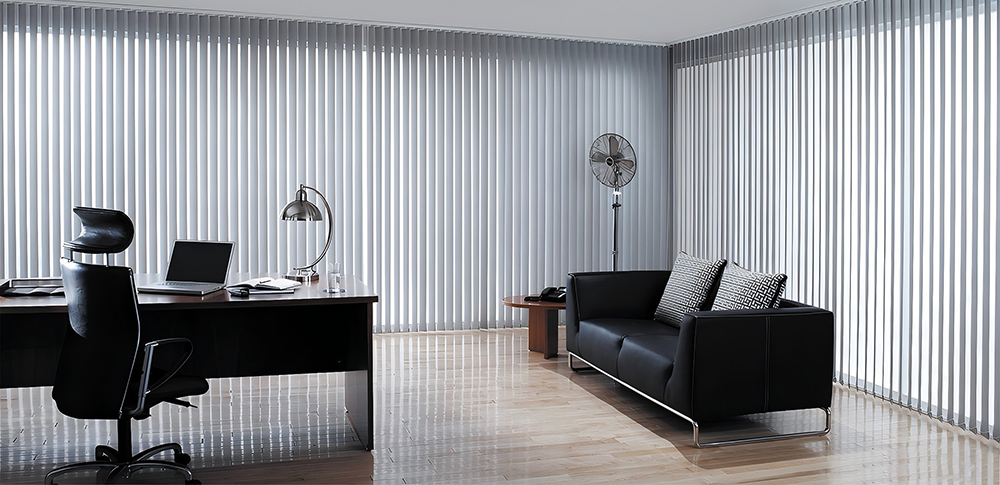
5 Practical, Undeniable Advantages of Vertical Blinds for Commercial Spaces
Unlike generic marketing posts that only highlight surface aesthetics, all benefits below are summed up from on-site project feedback and after-sales maintenance records, focusing on real usability for daily commercial operation.
1. Flexible Zoned Lighting Control for Mixed Office Layouts
The biggest competitive edge of vertical blinds lies in dual adjustment functions: independent slat rotation and full side-to-side sliding. Facility teams can tweak slat angles precisely to soften harsh midday sunlight without blocking outdoor views entirely. For modern open-plan offices with mixed working and meeting areas, you can leave one section of slats open for employee workstations that need natural light, while closing or angling another section to avoid screen glare during meetings and presentations. This targeted partial shading cannot be achieved by roller blinds or plantation shutters, making vertical blinds uniquely tailored for multi-functional office layouts.
2. Seamless Match for Oversized Floor-to-Ceiling Windows
Nearly all newly built office towers adopt full-height panoramic windows to expand indoor space visually, yet most standard blinds cannot fit such large window dimensions well. Featuring vertical slat structures, vertical blinds have almost no height limits for regular commercial windows. Their straight vertical lines create a neat, uniform look across all windows on the same floor, maintaining a unified corporate exterior and interior style. This consistent visual effect matters greatly for brand image and standardized office decoration for enterprise headquarters and branch offices.
3. Uninterrupted Airflow and Full Window Access
One often-overlooked merit of vertical blinds is unobstructed ventilation. Even when slats are fully closed to protect indoor privacy, narrow gaps between vertical slats still allow smooth air circulation, preventing the stuffy feeling caused by fully sealed window coverings. When users need to open windows for fresh air or clean exterior glass, the entire blind track can be slid completely to one side, leaving the whole window area open without occupying extra indoor floor space. This design also complies with fire code requirements for unobstructed emergency escape windows in commercial buildings.
4. Low Maintenance Needs and Extended Service Lifespan
Commercial spaces face high foot traffic and 8–10 hours of daily operation, so durability and easy maintenance are non-negotiable. Premium PVC and polyester slats used for commercial vertical blinds feature anti-static, dust-resistant and waterproof properties. Daily upkeep only requires a quick wipe with a damp microfiber cloth, with no need for complicated disassembly. With normal daily operation, high-quality vertical blinds can run smoothly for 5 to 8 years without slat deformation, color fading or track jamming, outperforming fabric curtains and low-grade horizontal blinds by a large margin.
5. Timeless Neutral Look Compatible with All Commercial Decor Styles
Most corporate offices, retail stores and public commercial areas stick to minimalist, industrial or modern light luxury design schemes. Vertical blinds feature slim, clean vertical lines and classic neutral color options including pure white, cool light grey and matte silver grey. These understated tones never clash with office furniture, wall paint or interior decorations, helping build a calm, focused and professional working atmosphere without overly decorative distractions.
Authoritative Selection Standards for Commercial Vertical Blinds
In most cases, poor user experience with vertical blinds stems from improper material or specification selection, rather than product quality defects. Below are universal industry selection rules refined from over 200 commercial blind projects, covering core purchasing factors for first-time buyers and project contractors.
• Material Selection Guide Based on Usage Scenarios
- PVC slats (Best for general office zones): Cost-effective, outstanding UV resistance and waterproof performance, ideal for regular office areas with fixed procurement budgets. The only minor downside is a slightly plastic texture compared to fabric alternatives.
- Polyester fabric slats (Best for high-end meeting rooms): Soft matte surface effectively reduces slat collision noise during adjustment, creating a quieter indoor environment. It matches premium office decoration perfectly for executive offices and formal boardrooms.
- Aluminum alloy slats (Best for mall corridors and public areas): Excellent heat resistance prevents slat deformation under long-term direct sunlight with no indoor air conditioning, suitable for high-temperature public commercial spaces.
• Slat Width Matching Rules
- 89mm slats: The industry mainstream choice for standard office vertical blinds. It balances light filtration, privacy and overall tidiness, fitting over 80% of regular office window sizes.
- 127mm slats: Designed for extra-large panoramic windows. Fewer slats deliver a cleaner, more minimalist overall look, avoiding a crowded visual effect on oversized glass surfaces.
• Manual vs. Motorized Control Options
- Manual cord control: The most budget-friendly option, reliable and easy to repair, perfect for standard-height office windows with easy manual access.
- Motorized smart control: Supports remote control, scheduled lighting adjustment and group synchronous control. It is the top pick for hard-to-reach high windows and intelligent modern office buildings.
Critical Mistakes to Avoid During Vertical Blind Installation
Even top-tier vertical blinds will perform poorly with sloppy construction, so standardized vertical blind installation is critical for smooth long-term use. Based on on-site construction experience, these three errors are the most common and easiest to prevent for commercial projects:
• Inaccurate measurement with no reserved margin: Always leave an extra 5 cm of width and height for top-mounted blinds to eliminate edge light leakage. For side-mounted installation, keep the track fully parallel to the window frame to prevent stuck slats during sliding.
• Ignoring indoor ceiling height: For offices with ceiling heights below 2.6 meters, avoid overly long slats touching the floor. Continuous friction will wear down slat edges and hinder smooth sliding over time.
• Separate batch procurement for same-floor windows: Always purchase all vertical blinds for one entire office floor in a single batch. Different production batches bring subtle color differences that ruin the unified interior and exterior visual effect of the whole building.
Frequently Asked Questions About Commercial Vertical Blinds
Q1: Are vertical blinds a better choice than horizontal blinds for regular office use?
A: For nearly all modern office spaces with large windows, yes. Vertical blinds deliver better natural ventilation, simpler monthly cleaning routines and more flexible side-sliding functions. Horizontal blinds work fine only for small, narrow office windows, while vertical blinds adapt to most full-height glass windows used in current office architecture.
Q2: Do vertical blinds rattle and make noise when indoor windows are open?
A: Quality commercial-grade vertical blinds come with durable bottom connector chains to fix every slat in place, which effectively stops rattling caused by indoor airflow. Only cheap low-end products without connecting chains produce obvious noise, so bottom chain accessories are a must-have for all commercial orders.
Q3: What is the recommended cleaning frequency for office vertical blinds?
A: For regular office environments, light dry dusting once a month is enough for daily maintenance. A full damp wipe every three months keeps slats clean and fresh. Thanks to their vertical layout, dust never accumulates heavily, making them far easier to maintain than horizontal blinds with stacked horizontal slats.
Q4: Can vertical blinds block harmful UV rays for sun-facing office windows?
A: Standard commercial vertical blinds can block 75% to 85% of harmful ultraviolet radiation. This protects office electronics, wooden desks and indoor furnishings from sunlight-induced aging, while still retaining soft, comfortable natural light inside the workspace.
Q5: Is it worth upgrading to motorized vertical blinds for office projects?
A: Motorized upgrades bring clear value for high windows, multi-window unified control projects and smart office buildings. They cut down manual wear on blind tracks, enable synchronous adjustment across all windows on one floor, and upgrade the overall intelligent office experience. For standard low windows with tight budgets, manual versions remain a cost-effective choice.
After years of serving commercial window treatment clients, I firmly believe that the best window covering is never the most expensive one, but the one that perfectly matches your space size, daily usage habits, long-term maintenance budget and overall decoration style. Vertical blinds have remained popular in commercial interior design for decades not because of trendy designs, but their steady, functional and cost-saving performance that fits long-term office operation needs perfectly. If you need customized size suggestions, material matching advice or professional installation solutions for your upcoming office renovation project, feel free to send us your window dimensions and project requirements for free one-on-one technical support.
Post time: Jul-14-2026