Faux wood blinds remain one of the most popular window treatment options for residential and commercial spaces, thanks to their affordable price, moisture resistance, and wood like aesthetic. Unlike real wood alternatives, premium hollow faux wood blinds resist warping, fading, and rotting, making them ideal for bathrooms, kitchens, sunrooms, and high humidity areas. However, the market is flooded with low grade faux wood products that cut corners on materials and craftsmanship. Many buyers, from household consumers to bulk wholesale purchasers, struggle to distinguish qualified products from inferior ones. Substandard blinds often bend easily, peel after short term use, or fail to withstand daily sunlight exposure, leading to frequent replacements and unnecessary cost losses.
How to Quickly Spot Inferior Hollow Faux Wood Blinds
Most low quality hollow faux wood blinds show obvious physical flaws that can be identified without professional testing equipment. For buyers who need to check product quality quickly during sampling or on site inspection, three simple and effective methods work best for preliminary screening.
First, conduct a weight and firmness test. Qualified hollow faux wood blinds adopt sufficient PVC raw materials with uniform density, delivering a solid and steady hand feel. Inferior products usually feel noticeably lighter and softer. When you gently press the slat surface or shake the blind panel, low grade slats will wobble obviously, as manufacturers reduce core material dosage to lower production costs. This insufficient material foundation directly causes poor structural stability.
Second, observe the inner wall of hollow slats. Cutting open a small section of the blind slat reveals the most intuitive quality difference. High quality hollow faux wood features smooth, compact, and uniform inner walls without tiny bubbles, particle impurities, or uneven thickness. In contrast, inferior slats have loose inner structures with dense bubbles and irregular voids. These internal defects make the blinds prone to deformation and cracking under temperature changes or slight external pressure.
Third, test basic abrasion and compression resistance. Rub the slat surface slightly or apply gentle pressure on the edge. Poor quality faux wood will produce white indentations, surface powdering, or minor deformation. Such products cannot resist daily friction and long term UV exposure, and they are more likely to collapse or bend after months of use, especially in spaces with strong sunlight or frequent window opening and closing.
Why PVC Core Density Determines Blind Service Life
PVC core density is the core hidden standard that distinguishes high end and ordinary faux wood blinds, and it is also the most overlooked indicator by most buyers. Many consumers only focus on surface color and texture, ignoring that the internal PVC structure fundamentally decides the product’s durability, deformation resistance, and environmental adaptability.
Qualified PVC faux wood blinds require a stable and standardized density value, which ensures the overall toughness and structural tightness of each slat. Blinds reaching the industrial standard density can maintain flatness in high temperature, humid, and dry environments, effectively resisting aging, shrinkage, and permanent deformation. This stable performance makes them suitable for long term use in family houses, office buildings, hotel projects, and outdoor sunshade scenarios.
On the contrary, faux wood blinds with insufficient PVC density have loose internal structures and insufficient molecular tightness. Although they look similar to qualified products in appearance, their service life is greatly shortened. After several months of sunlight exposure and air humidity changes, these slats will gradually warp, bend, or even break. For bulk purchasers, low density products mean extremely high after sales maintenance costs, customer complaints, and brand reputation losses.
For bulk order inspection, simple sampling detection can effectively avoid unqualified goods. Randomly select multiple slats from different batches for weighing comparison and section observation. Uniform weight and compact section structure always represent stable and qualified PVC core quality.
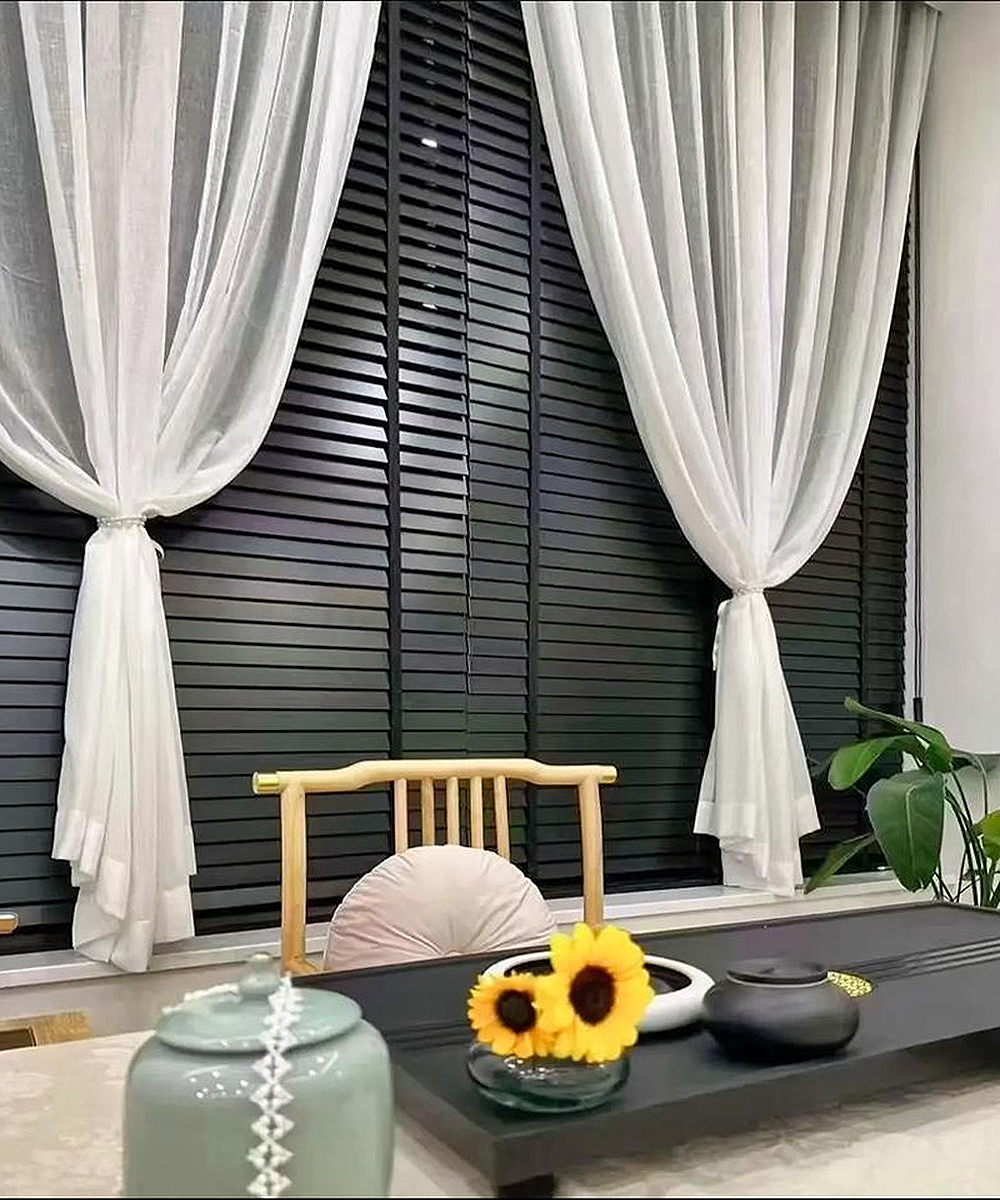
Laminated vs Sprayed Finish Which Surface Coating Is More Durable
Surface coating technology directly affects the texture, wear resistance, and weather resistance of faux wood blinds. Many buyers confuse lamination and spray coating finishes, unaware that the two crafts have huge differences in service life and application scenarios. Choosing the right surface finish is crucial for long term use and cost performance.
Spray coating is a common and cost effective surface treatment process. The slat surface is covered with a thin layer of sprayed paint, which supports diverse color matching and simple wood grain simulation. Its biggest advantage is low production cost and flexible color customization, suitable for low budget interior decoration and short term engineering projects. However, the sprayed layer is thin with limited adhesion. After long term UV irradiation and daily friction, the paint layer is prone to fading, peeling, and scratching, resulting in an outdated and worn looking window appearance.
Laminated finish is a high end surface treatment solution for premium faux wood blinds. It adopts integrated PVC film lamination technology, attaching a thick, high density wood grain film tightly to the slat surface. The laminated layer features excellent sealing performance, effectively isolating air moisture and ultraviolet rays. Compared with sprayed coating, laminated surfaces are scratch resistant, fade proof, and waterproof, with more realistic and delicate wood grain texture. The overall wear resistance and weather resistance are several times higher than sprayed products, supporting long term use for more than ten years in most indoor and semi outdoor environments.
In practical application selection, sprayed faux wood blinds fit temporary renovation, low budget residential rental projects, and low frequency use spaces. Laminated faux wood blinds are more suitable for high end home decoration, commercial office spaces, star hotel engineering orders, and long term fixed installation scenarios, balancing beauty and ultra long service life.
Key Inspection Items for Bulk Faux Wood Blind Orders
For wholesale buyers, project purchasers, and distributors, single sample inspection is not enough to guarantee overall order quality. A complete set of pre shipment inspection standards can effectively avoid batch quality problems and stabilize customer satisfaction.
First, conduct PVC core density sampling inspection to ensure consistent material standards of all batches of slats, avoiding mixed loading of high and low density materials. Second, test surface coating adhesion and wear resistance to confirm no peeling, fading, or scratching under normal friction. Third, check slat flatness to ensure each piece is straight and free from bending, warping, or irregular radian. Fourth, verify UV resistance and color fastness to adapt to different light and climate environments. Finally, inspect the matching quality of supporting accessories to ensure smooth lifting and flipping of the whole blind system without jamming or loosening.
Q&A
Q1: How to tell hollow poor quality faux wood blinds quickly?
You can identify inferior hollow faux wood blinds rapidly through weight check, inner structure observation, and simple pressure testing. Unqualified products are lighter in weight with loose inner PVC structures filled with tiny bubbles and voids. They feel soft when pressed and are easy to deform or turn white under slight external force, while qualified products have solid texture, uniform inner walls, and stable overall structure.
Q2: Which surface finish lasts longer, laminated or sprayed faux wood?
Laminated finish has a far longer service life than sprayed finish. The thick integrated laminated film provides strong UV resistance, scratch resistance, and waterproof performance, maintaining stable color and texture for years. Sprayed coating is thin and weakly adhesive, prone to fading and peeling after long term sunlight exposure and daily friction.
Q3: What density should qualified PVC faux wood reach?
Qualified PVC faux wood blinds must meet standardized industrial density parameters to ensure structural stability. Standard density enables the slats to resist deformation, moisture, and aging, which is the most fundamental indicator to distinguish high quality products from inferior ones. Products reaching standard density can adapt to various climate environments and maintain long term flatness and durability.
If you are looking for reliable faux wood blinds with strict PVC core standards and premium surface finishes, we provide customized wholesale solutions for global clients. All our products undergo full quality inspection before shipment, supporting sample testing and bulk order cooperation to meet residential and commercial project needs.
Post time: Jul-30-2026