Window coverings are one of the most overlooked household safety hazards for young children in the United States. According to long-term CPSC safety surveillance data, exposed pull cords on venetian blinds cause dozens of child strangulation incidents every year, prompting strict federal regulatory updates for residential nursery and kids’ bedroom window treatments. For homeowners, interior designers, and window covering suppliers, understanding and complying with the latest CPSC cord safety rules is no longer optional—it is a mandatory requirement to create safe living spaces and avoid regulatory penalties.
The U.S. Consumer Product Safety Commission (CPSC) has enforced rigorous cord safety regulations under 16 CFR Part 1260 and ANSI/WCMA A100.1-2018 standards, targeting all venetian blinds installed in rooms for children aged 8 and under. These rules specifically govern three mainstream venetian blind types: faux wood, aluminum, and PS blinds, clarifying clear cordless modification specifications and strict forbidden standards for exposed pull cords.
Core CPSC Cord Safety Rules for Children’s Bedroom Blinds
To eliminate child strangulation risks, the CPSC classifies accessible window covering cords as a substantial product hazard under Rule 15(j). Unlike general window treatment standards, the kids’ bedroom regulations feature zero-tolerance for high-risk cord designs, with universal applicability for custom and stock venetian blinds sold or installed in the U.S. market.
The first critical rule limits exposed cord length: any operating pull cord that is reachable by children cannot exceed 8 inches in total exposed length. More importantly, all looped cord structures are completely prohibited. Looped cords are the leading cause of toddler and infant strangulation accidents, as they can easily trap children’s heads and necks during active play. For families and installers, this means trimming cords is not enough—any retractable or looped cord design must be completely restructured for child-facing rooms.
The second core requirement prioritizes full cordless operation. CPSC strongly recommends cordless control structures for all kids’ bedroom blinds, including push-pull wands, side tilt levers, and magnetic lifting systems. If partial cord retention is unavoidable for special installation scenarios, the remaining cords must be fully locked and non-extendable, with automatic retraction devices that eliminate loose hanging sections permanently. Non-compliant blinds face official market removal, forced recalls, and customs detention for cross-border products.
Material Specific Cordless Modification Specifications
Most users struggle with targeted refit solutions, as different venetian blind materials have distinct structural limitations and modification feasibility. Below are practical, CPSC-compliant cordless refit standards tailored to faux wood, aluminum, and PS venetian blinds, suitable for existing blind renovation and new product customization.
Faux Wood Venetian Blinds: Faux wood blinds feature thick, heavy slats and stable frame structures, making full cordless conversion completely feasible and highly recommended. The standard refit solution removes all traditional lifting cords and tilt cord assemblies entirely. Replace cord operation with side-mounted push rods or magnetic lifting control systems. All internal cord routing components are fully enclosed inside the top headrail with no external access. For nursery installations, partial cord retention is not permitted, ensuring zero exposed cord contact for infants and toddlers.
Aluminum Venetian Blinds: Lightweight aluminum blinds are widely used in kids’ rooms due to their durability and affordability. Their modification focuses on hidden cord optimization rather than full cord removal. The compliant design adopts an integrated cordless tilt wand for angle adjustment, with all lifting cords concealed within the sealed headrail. If auxiliary fixed cords are required for structural balance, the exposed length must stay under 8 inches and be firmly fixed without stretching or swinging. This design balances daily usability and child safety, ideal for family bedroom renovations.
PS Venetian Blinds: PS foam venetian blinds are popular budget-friendly options for residential use, and many homeowners wonder if old corded models can be upgraded. The CPSC compliant refit standard allows full cordless transformation by removing external pull cord sets and installing one-piece push-pull control structures. The lightweight slat design matches cordless operation perfectly, requiring no frame replacement. This cost-effective refit method helps users upgrade old blinds to meet federal safety standards without full product replacement.
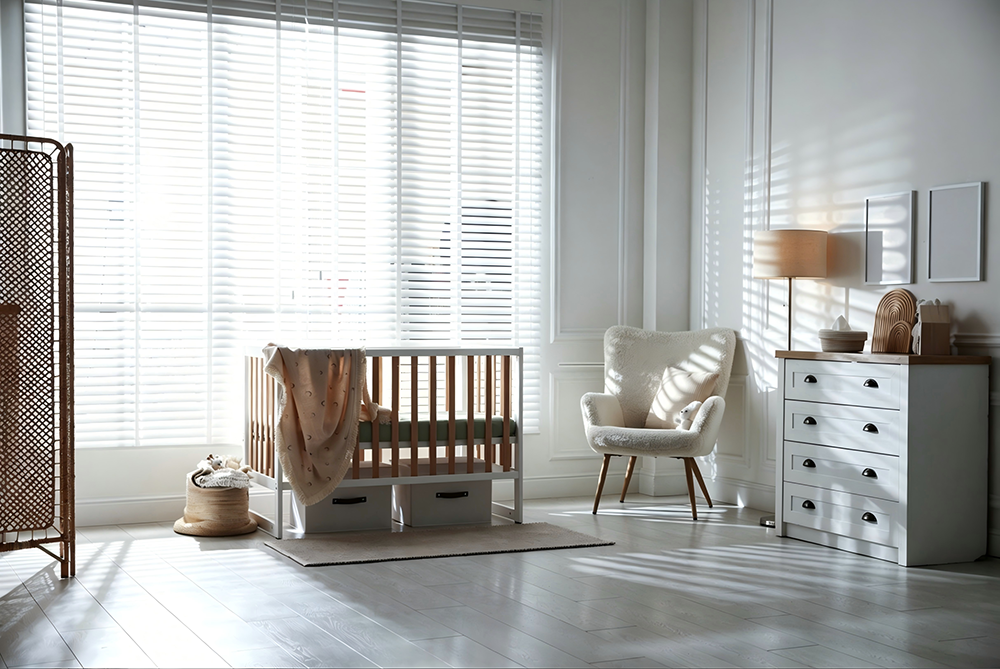
Strict Forbidden Pull Cord Standards for Nursery Window Treatments
Nurseries for infants aged 0 to 3 years follow stricter CPSC safety thresholds than ordinary kids’ bedrooms, with absolute restrictions on pull cord installations. No exposed pull cord venetian blinds of any material are approved for nursery use, regardless of trimmed cord length or fixed installation methods.
The core nursery compliance principle is 100% inaccessible cord structures. Any window treatment with manually operated external pull cords, looped cord segments, or loose retractable cords violates federal safety rules. Only fully cordless wand-operated or fixed hidden-cord blinds qualify for infant room installation. It is critical to note that adult bedroom blind safety standards cannot be applied to nurseries, as infant mobility and self-risk awareness are far lower, requiring maximum hazard elimination.
Frequently Asked Questions
Q1: What official CPSC regulations apply to blinds installed in children’s bedrooms?
A1: Kids’ bedroom blinds comply with CPSC Rule 15(j) for substantial product hazards, paired with ANSI/WCMA A100.1-2018 and 16 CFR Part 1260 federal standards effective May 30, 2023. The rules mandate cordless or fully inaccessible cord designs for blinds used by children under 8, banning exposed operating cords over 8 inches and all accessible cord loops to prevent strangulation risks.
Q2: Can traditional corded PS venetian blinds be modified to meet CPSC cordless safety standards?
A2: Yes. Standard corded PS blinds support complete cordless refit without full replacement. By removing external pull cord assemblies and installing integrated push-pull or tilt wand control structures, existing PS blinds can fully comply with CPSC kids’ bedroom safety requirements. This is a low-cost, practical solution for home renovation and safety upgrade projects.
Q3: Are pull cord faux wood blinds allowed for infant nursery rooms?
A3: No. All exposed pull cord faux wood blinds are strictly banned for infant nurseries under CPSC regulations. External pull cords create unavoidable strangulation hazards for young infants. Only fully cordless faux wood blind configurations are permitted for nursery window treatments to ensure complete child safety.
Whether you are renovating a child’s bedroom, replacing old window coverings, or sourcing compliant blinds for residential projects, adhering to the latest CPSC cord safety standards is the most reliable way to eliminate household safety risks and meet U.S. market compliance requirements. Targeted cordless modification based on blind material characteristics ensures both safe operation and daily usability, avoiding unnecessary replacement costs while fully meeting federal regulatory specifications.
Post time: Aug-04-2026