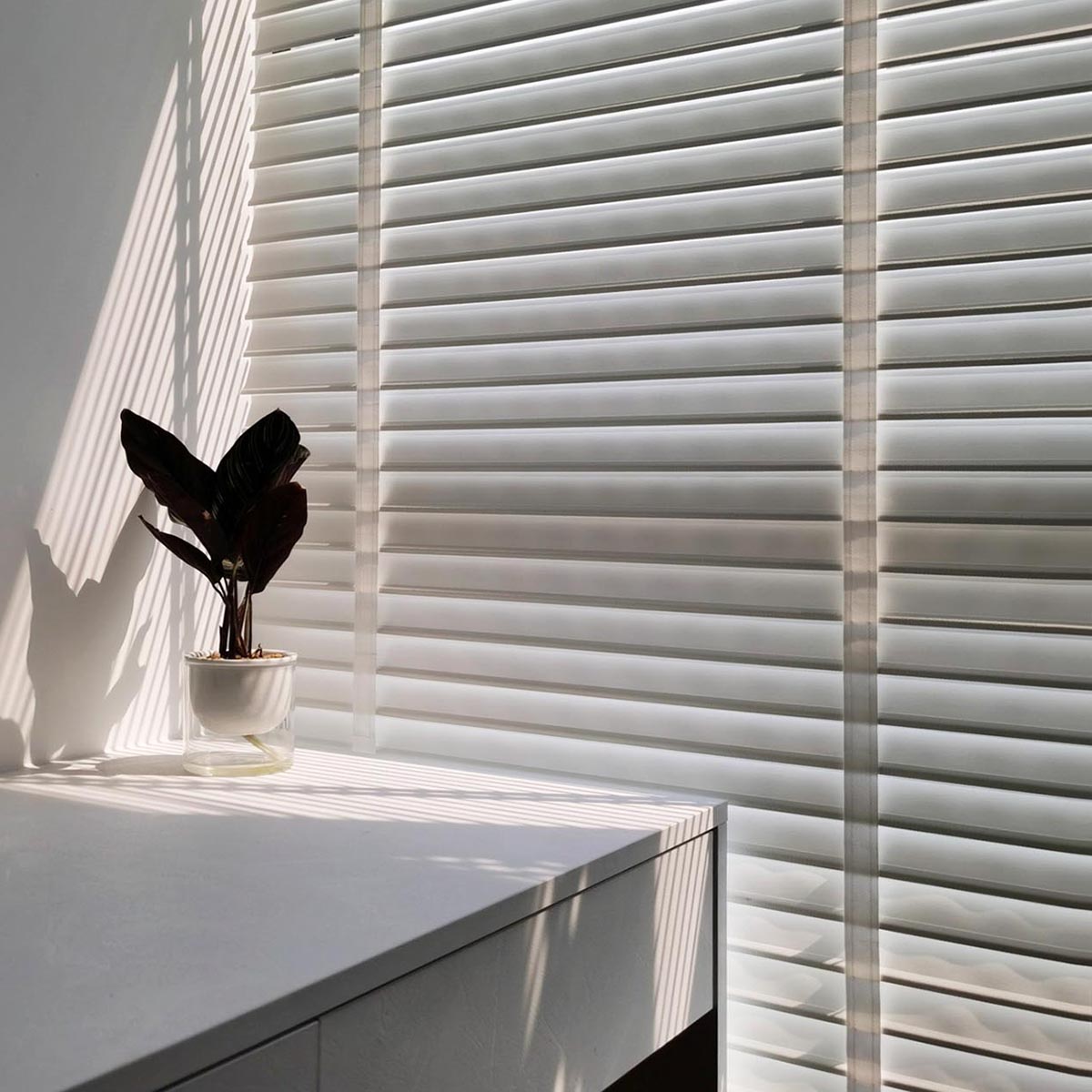
At the luminous boundary of architectural spaces, window blinds, with their distinct slat matrix mechanism, serve as the implicit regulator of modern living rhythms. This dual-carrier spanning household accessories and spatial installations not only achieves the organic integration of functional demands and aesthetic expression but also constructs a crucial medium connecting practical rationality and poetic dwelling. When the first ray of morning sunlight penetrates the gaps between blind slats to form light gratings, the interwoven texture of light and shadow cast indoors constitutes the initial visual narrative that awakens spatial perception.
1. Light Environment Regulation: The Mechanism of Precision Optical Intervention
The core technical advantage of window blinds lies in their continuous gradient light adjustment capability, which is essentially different from the binary optical model of “full transparency-full occlusion” of traditional fabric curtains. Through stepless adjustment of slat angles (typically achievable with precise positioning within the 0°-180 range), they enable refined control over incident luminous flux, illuminance distribution, and light projection direction. For morning reading scenarios, a 15 slat angle creates a directional diffused light field to avoid glare interference; during afternoon relaxation, a 45 angle effectively reduces ultraviolet radiation (with a blocking rate of 60%-80%); and in the evening, a 75 angle maintains outdoor landscape visibility while preserving indoor privacy. This dynamic optical intervention not only adapts to the light environment needs of different time periods and activities but also endows static spaces with the temporal dimension of flowing light and shadow. As Tadao Ando stated in Architecture of Light and Shadow, “The vitality of architecture originates from the intervention of light.” Window blinds precisely act as the materialized carrier of this intervention, realizing a poetic dialogue between human settlements and natural light through the continuous reconstruction of luminous boundaries.
2. Spatial Aesthetic Expression: Weak-Intervention Order Construction
In the dimension of environmental aesthetics, window blinds exhibit remarkable spatial adaptability and contextual expressiveness. The linear order formed by their modular slat structure can visually resonate with the geometric aesthetics of modern minimalism, enhancing structural hierarchy in loft spaces; meanwhile, solid wood blinds can integrate into the humanistic context of new Chinese-style or classical studies through texture correspondence. This design logic of “both integrating into and enhancing the space” highly aligns with the core viewpoint of Kengo Kuma’s “negative architecture” theory—that architecture should humbly integrate into the environment rather than strongly defining it. Window blinds do not pursue spatial dominance; instead, they endow spaces with variability and breathability through changes in slat opening angles. With the increasing popularity of parametric design, customized window blinds can further become an implicit design language to resolve spatial proportion imbalances and optimize visual circulation through precise matching of slat spacing and material light transmittance. Their low-saturation aesthetic characteristics precisely embody the microcosmic interpretation of the contemporary design philosophy of “less is more.”
3. Practical Performance Dimension: Systematic Optimization of Materials and Functions
The practical value of modern window blinds is built on the dual support of materials science and environmental engineering. Aluminum blinds undergo anodization treatment to achieve both enhanced weather resistance and moisture resistance, with a service life of over 15 years in the humid subtropical climate of southern China. PVC Venetian Blinds, relying on their stain resistance and easy cleanability, address the industry pain point of dust accumulation and mildew in traditional fabric curtains (reducing cleaning frequency to 1/3 of that required for traditional curtains). In terms of ventilation performance, the air guiding channels formed by slat gaps can increase indoor air exchange efficiency by 20%-30%, effectively alleviating stale air accumulation in enclosed spaces. More notably, their passive energy-saving effect: optimizing slat angles in summer can block over 70% of solar radiant heat, reducing indoor air conditioning load by 30%; in winter, maximizing lighting area enhances solar radiant heat gain, cutting heating energy consumption by approximately 15%. This thermodynamic characteristic of “summer heat insulation and winter light transmission” accurately responds to the contemporary demand for sustainable human settlements.

4. Response to Psychological Needs: The Humanistic Construction of Boundary Perception
The in-depth value of window blinds lies in their precise response to the psychological needs of modern residents. Against the dual backdrop of information overload and the privatization of public domains, individuals’ desire for control over spatial boundaries and demand for privacy are increasingly prominent. Through gradient adjustment between “physical shielding and visual transparency,” window blinds construct autonomously controllable spatial boundaries—complete closure forms a physical barrier to meet the need for solitude; a half-open state achieves visual buffering of “visible but inaccessible,” striking a balance between openness and privacy. This design implicitly aligns with Albert Camus’ philosophical proposition that “the meaning of life lies in the experience of beauty and freedom,” providing modern people with a spatial tool to counter existential anxiety through material functionality. As night falls, the gentle closure of slats accomplishes the tender separation of indoor and outdoor spaces. This dual attribute of “connection-separation” serves as a spatial metaphor for the living state of modern individuals: longing for connection with the outside world while needing to reserve a spiritual territory for solitude.
From the technical intervention of architectural optics to the poetic expression of spatial aesthetics, from the ecological value of passive energy conservation to the response to humanistic psychology, window blinds have transcended the physical attribute of window decorations to become “spatial regulators” in modern human settlements. With the opening and closing rhythm of their slats, they synchronize the rhythms of natural light and human life, embodying the survival wisdom of contemporary human settlements in the balance between practical rationality and poetic dwelling.
Post time: Dec-15-2025